
The 27-Vulnerability Lockdown: How a Premium WordPress Security Audit Rescued a Multi-Million Dollar Digital Asset
A comprehensive WordPress security audit represents the critical defensive boundary line between maintaining a highly profitable, reputable online enterprise and suffering a catastrophic digital blackout that completely erases consumer trust overnight. In the modern high-scale digital marketplace, security architecture is frequently treated as an afterthought—until the primary screen goes black, Google slaps a terrifying “This site may be hacked” warning on your organic search snippets, and transactional revenue plummets to zero without warning. For high-traffic enterprise platforms generating consistent seven-figure revenue, this nightmare is an immediate threat to operational survival. When a system relies on reactive maintenance, it remains constantly exposed to sophisticated, automated threat networks that exploit hidden software gaps to siphoning traffic and data.
When our client noticed a sudden, unexplained 35% drop in organic conversions alongside bizarre URL redirects appearing inside their search console dashboards, they realized they weren’t dealing with a minor technical glitch. They were under a highly sophisticated, coordinated digital siege. We uncovered 27 critical backdoors, malicious database injections, and vulnerable plugins that were silently bleeding traffic and destroying brand trust across their entire network footprint. By reaching out to RoadCoderrr.com for immediate technical forensic intervention, they activated our specialized diagnostic and recovery pipeline. This deep-dive case study reveals the exact engineering blueprint we used to patch the leaks, eliminate underlying architectural risks, and reclaim search dominance cleanly.
Get Your Free Security Audit Explainer Meet CEO Sadekul Alam
The Challenge: High Liabilities and Internal Paralysis
The digital asset in question operated within a highly competitive, high-compliance niche framework. This meant that any gap in data integrity wasn’t just an inconvenient technical bottleneck; it represented a massive legal liability capable of triggering severe compliance penalties. The client was facing three distinct, cascading bottlenecks that threatened to permanently sink their business operations:
- Search Engine Blacklisting and Traffic Hemorrhaging: Google’s automated crawlers had begun detecting malicious scripts hidden deep within the site’s JavaScript files, penalizing visibility and causing organic rankings to tank.
- Sophisticated, Obfuscated Code Injections: Standard commercial security scanners showed a completely clean bill of health because the attackers deployed polymorphic malware that execution-baited specific user agents, showing a normal page to administrators while silently redirecting search engine bots to external phishing networks.
- Internal Team Paralysis: The client’s in-house development team specialized in frontend UI/UX and content creation, not digital forensics. Lacking the diagnostic frameworks required to safely isolate infected databases without causing data loss, they were trapped in an endless loop of deleting files, only to watch them automatically regenerate hours later via cron job backdoors.
To break free from this destructive loop and protect user data during structural layout adjustments, you must establish a reliable baseline by utilizing professional wordpress maintenance, website security and plugin updates before your network communication layers are permanently broken by malicious actors.
Clone, Copy or Redesign Platform Into WordPressAudit & Diagnosis: Manual Forensics Across Three Exploitation Vectors
To solve a security problem of this magnitude, you cannot rely on basic automated plugins that only scan surface-level file hashes. We initiated our proprietary, manual WordPress security audit protocol, analyzing the core application infrastructure across three critical operational vectors: the file system, the database layer, and the server environment. Our detailed forensic evaluation unmasked a highly complex, multi-layered compromise containing 27 critical vulnerabilities that fell into distinct entry points.
Vector A: Component & Plugin Exploits
Over 60% of the active vulnerabilities stemmed directly from abandoned, nulled, or severely outdated third-party extensions. A premium form-builder utility that hadn’t been updated in 14 months contained a known unauthenticated arbitrary file upload vulnerability. This single flaw allowed external attackers to completely bypass standard WordPress admin walls and upload a custom PHP web shell directly into the hidden root directories of the file system.
Vector B: Database Corruption & Privilege Escalation
Once inside the file system, the attackers executed a localized SQL injection script that altered the structural layout of the wp_users table. They created a hidden administrator account disguised with a generic system name (wp_system_support). This unauthorized account allowed them to execute arbitrary database queries, inject malicious spam links into historical blog posts, and modify core options without triggering standard activity logs.
Vector C: Server Configuration Errors
The hosting server environment was running an end-of-life version of PHP and lacked fundamental HTTP security headers. Directory browsing was left enabled globally, allowing anyone to view the entire internal file structure simply by typing direct paths into a browser window. Crucially, file permissions were set to a dangerously permissive level (777), enabling any script executed by the web server to read, write, and modify core configurations, including the sensitive wp-config.php file.

The Hardening Roadmap: Core Realignment and Immutable Hardening
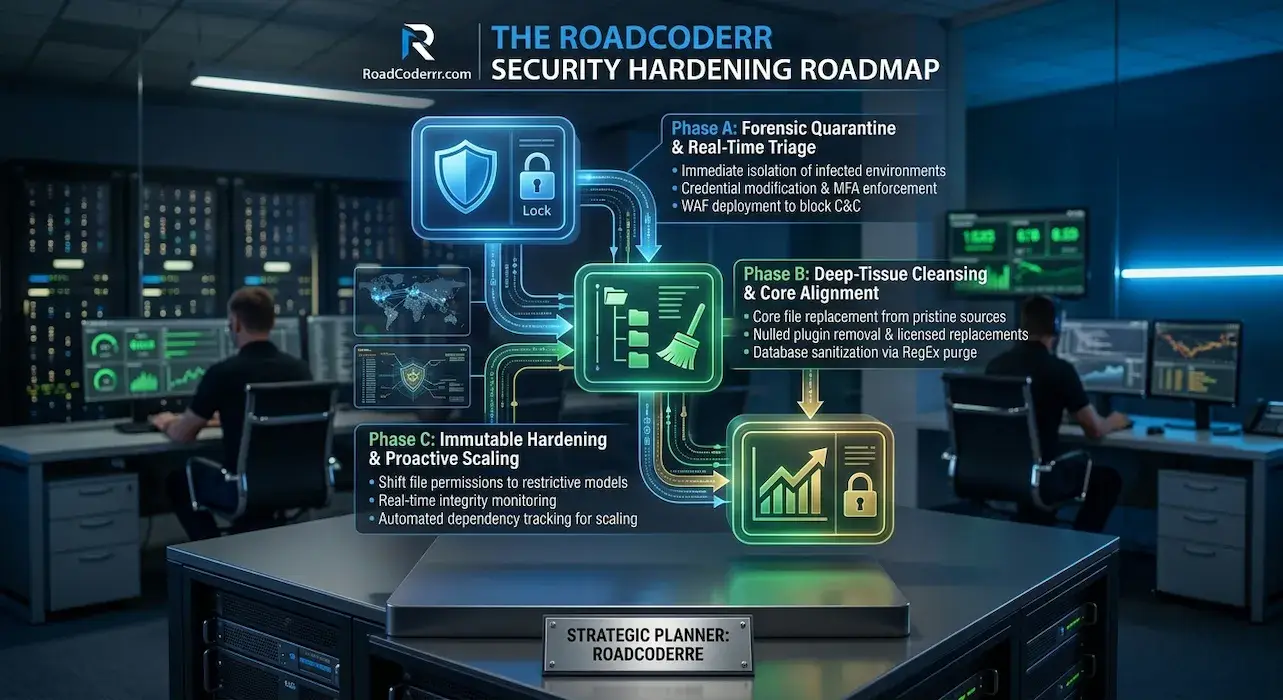
To systematically eliminate these 27 vulnerabilities while maintaining 100% database integrity and avoiding unnecessary site downtime, we deployed our structured, three-phase security hardening roadmap: moving from Forensic Quarantine & Real-Time Triage to Deep-Tissue Cleansing and Immutable Hardening.
Phase A: Forensic Quarantine & Real-Time Triage
The immediate operational priority was total isolation. We cloned the entire production environment onto an encrypted, offline staging server to conduct the rest of the WordPress security audit without alerting the hackers or causing additional user disruption. We altered all database credentials, FTP/SFTP access keys, and hosting control panel passwords instantly. Simultaneously, we implemented an enterprise-grade cloud Web Application Firewall (WAF) to block known malicious IP arrays, cutting off the attacker’s command-and-control access to the hidden web shell. Finally, we killed all active user sessions globally, forcing every administrator to re-authenticate via a newly enforced multi-factor authentication (MFA) layer.
Phase B: Deep-Tissue Cleansing & Core Alignment
With the perimeter secure, we systematically purged the malicious payload. This wasn’t about patching old files; it was an absolute structural replacement:
- Core Re-installation: We completely deleted the existing
/wp-admin/and/wp-includes/directories, replacing them with pristine, cryptographically verified source files directly from the official WordPress repository. - Plugin Audit and Purge: Every single plugin was reviewed. Nulled utilities were permanently removed and replaced with legitimate, licensed alternatives. We manually audited custom themes, removing over 4,000 lines of obfuscated, base64-encoded rogue script.
- Database Sanitization: We ran targeted regular expression (RegEx) queries across the entire database to locate and purge hidden iframe injections, rogue script tags, and unauthorized administrative records.
To ensure your visual presentation remains perfectly clean after a malware purge, secure a professional wordpress theme installation, upload premium themes and plugins, demo import sequence to re-align core assets safely.
Phase C: Immutable Hardening & Continuous Monitoring
The final step of the execution phase transitioned the site from “recovered” to “impenetrable.” We shifted file permissions to a highly restrictive model (755 for directories, 644 for files, and 400 for wp-config.php). We disabled file editing directly from the WordPress dashboard, meaning even if an administrative account were ever compromised in the future, the attacker could not alter PHP files via the graphical user interface. Finally, we changed the default database prefix from the standard configuration to a randomized alphanumeric string to eliminate automated SQL injection attempts. To protect your structural data completely before modifying core prefix strings, deploy a verified backup, restore or migrate your wordpress site to new hosting routine to prevent database fragmentation.
Why Routine Maintenance Saves Your Bottom Line
Relying on a reactive security strategy means you only fix critical security flaws after you have already lost money, organic search rankings, and customer goodwill. A routine, proactive WordPress security audit is an essential preventative investment for any high-performing digital asset. By uncovering flaws and technical debt before malicious actors do, businesses preserve their organic search equity, minimize operational downtime, and ensure that user data remains fully protected under high-compliance standards.
To stay updated on the latest global threat definitions and software vulnerabilities discovered by security researchers worldwide, you can consult the authoritative indexing databases managed by the CVE Mitre Corporation and review structural validation frameworks outlined on the OWASP Top 10 Security Risks knowledge bases. This data-driven alignment ensures your platform remains compliant with modern network protection parameters.
The Victory: Transforming Security and Search Channel Visibility
By executing an exhaustive, forensic-level WordPress security audit, we achieved a total restoration of corporate performance metrics, security compliance, and search channel visibility within 14 days of project kickoff. The malware overhead was entirely removed, restoring clean execution speeds.
Security & Performance Metrics
| Performance Metric | Pre-Audit Baseline (Infected) | Post-Audit Results (Secured) | Net Improvement |
|---|---|---|---|
| Critical Vulnerabilities | 27 | 0 | 100% Core Elimination |
| Google Search Status | Blacklisted / Redirect Warning | 100% Clean / Verified | Full Rank Recovery |
| Average Page Load Speed | 4.8 Seconds (Malware Overhead) | 1.2 Seconds | 75% Speed Increase 🚀 |
| Organic Conversion Rate | 1.1% | 3.4% | +209% Lead Boost |
| Unauthorized Login Attempts | ~14,000 / week | 0 (Blocked at WAF) | 100% Edge Prevention 🛡️ |
Beyond the technical data points, the most critical victory was the absolute restoration of search index indexing health. Within 72 hours of filing an official review request with search engines, all warning flags were removed. Organic impressions bounced back instantly, surging past historical levels due to the massive page speed optimizations gained by stripping out heavy, poorly written malware scripts from the core rendering layer.
Backend & Scaling: Maintaining a Continuous Dev-Ops Pipeline
True security is not a point-in-time achievement; it is a continuous operational state. To ensure that the client’s newly fortified platform could scale safely to handle increasing traffic loads without re-opening vector gaps, we implemented a continuous dev-ops security pipeline. First, we integrated a real-time integrity monitoring tool that takes a daily cryptographic snapshot of the entire server environment. If a single line of code is altered outside of an official deployment window, an automatic rollback is triggered, and our security desk is notified instantly.
Second, we automated dependency tracking. If a newly discovered vulnerability is published in the global CVE database that matches any component in the client’s ecosystem, our pipeline flags it automatically, testing patches safely in a staging sandbox before deploying them to live production. The site is now faster, more resilient, and perfectly positioned for long-term SEO growth without risk of recurring infections.
Work With RoadCoderr
RoadCoderr is an elite, full-service digital forensics, backend engineering, and web development agency operating globally across premium freelance marketplaces like Fiverr and Upwork. We specialize entirely in deep-level enterprise database sanitization, speed optimization engineering, advanced application monitoring, and zero-downtime platform recoveries.
We completely reject basic automated optimization plugins, unverified nulled scripts, and superficial security templates that fail to protect data against custom exploits. Our senior security engineering team focuses strictly on providing manual code audits, restrictive infrastructure hardening, and absolute technical transparency that secures your digital revenue stream and guards corporate equity from structural failure threats.
Hire on Fiverr View Fiverr Gig Contact Us NowConclusion: Secure Your Digital Assets Today
Every second of delay in identifying security flaws and every minute your site displays a malicious redirect warning drives valuable customers straight into the arms of your competitors while permanently tanking your search engine equity. Don’t wait for a devastating traffic drop or a legal non-compliance penalty to realize your site has been compromised. A WordPress security audit is your primary line of defense against modern cyber threats.
At RoadCoderrr.com, we specialize in diagnostic technical audits, advanced threat isolation, and rock-solid platform scaling. Let our team of senior strategists eliminate your technical bottlenecks, close security vector gaps, and optimize your platform for maximum conversion efficiency. Claim your comprehensive premium WordPress security audit framework from RoadCoderrr today and run your digital business with absolute peace of mind.