
Elementor Website Cloning: The Code-Free Blueprint for High-End Sites
Elementor website cloning is often viewed by developers as a compromise. The common industry assumption is that replicating a complex, high-end, bespoke website into a visual page builder requires either massive sacrifices in design fidelity or an overwhelming amount of custom CSS and JavaScript overrides. At RoadCoderr, we reject that premise. When an enterprise client approached us needing a complete architectural migration of their pixel-perfect, custom-coded platform, we utilized advanced Elementor website cloning strategies to deliver a flawless replication. This comprehensive case study details exactly how we achieved complete design parity and enhanced performance without writing a single line of custom code.
The client’s original platform was a marvel of modern web design—and a nightmare for their marketing team. Built entirely on a decoupled, custom-coded framework, every minor text adjustment, seasonal promotion, or new landing page required a formal developer ticket, a staging deployment, and hours of billed engineering time. This infrastructure created severe operational bottlenecks, paralyzing the marketing team and inflating maintenance overhead. By executing a meticulous Elementor website cloning framework, we transformed their rigid layout into an agile asset. To ensure the new system remained perfectly stable, we backed it up with our standard wordpress maintenance protocols, protecting the underlying codebase from future security or performance regressions.
The objective was straightforward yet daunting: migrate the entire digital asset into WordPress. The new site needed to empower non-technical staff to execute layout changes fluidly, while preserving the complex interactive grids, precise typography, dynamic filtering, and premium aesthetic of the original site. It was the ultimate test for an Elementor website cloning methodology. To maintain a pristine deployment from the start, our technical desk combined the migration with a clean wordpress theme installation, upload premium themes and plugins, demo import sequence, establishing an unshakeable core architecture that mirrors the high-end framework of the original build.
Many brand managers fear that migrating away from hardcoded files will expose their business to severe web threats. While poorly configured page builders can sometimes introduce vulnerabilities, a disciplined deployment entirely eliminates these risks. During our migration process, we integrate advanced server hardening to prevent common infections before they can manifest. If your existing site has already been compromised by unpatched scripts during past management cycles, our specialized technicians can implement an emergency wordpress malware, fix hacked websites and redirecting issues sweep to purify your assets before transferring them into a visual ecosystem.
When executing complex data transitions, preserving historical database relationships and media paths is vital. For this enterprise project, our team deployed a zero-downtime staging pipeline that handled the heavy data processing off-site. For businesses looking to move their assets to optimized hosting environments without losing search authority, our dedicated backup, restore or migrate your wordpress site to new hosting workflow guarantees a secure handoff. Let our expert engineers handle the stress of system transformations safely.
Get Your Free Migration Blueprint Meet CEO Sadekul Alam
The Operational Bottlenecks of Custom-Coded Stacks
While custom-coded sites provide clean structural environments initially, they frequently become a massive bottleneck for fast-moving commercial brands. The marketing team remains completely dependent on external developers to make simple content tweaks, leading to massive delays in campaign rollouts. This rigid architecture stops real-time market responses, drains internal budgets, and kills conversion opportunities during key seasonal sales events.
Choosing an advanced Elementor website cloning strategy removes this friction entirely by shifting code control into an intuitive visual dashboard. Non-technical administrators can build fresh landing pages, update copy, and adjust structural segments layout-wise without breaking underlying database tables. This operational agility allows your marketing desk to focus entirely on user retention, split testing, and revenue scaling rather than waiting on developer queues.
Additionally, keeping legacy custom code secure requires ongoing manual regression checks whenever server configurations update. A modular page builder system, when combined with routine website security and plugin updates, streamlines this process. Your platform gains access to automated patching rules, keeping your structural integrity high and lowering long-term maintenance costs significantly.
Audit & Diagnosis: Mapping Technical Dependencies
Before launching a sandbox terminal, our engineering team conducted a comprehensive technical audit of the source platform. We mapped every structural, asset, and functional dependency to understand the scope of the Elementor website cloning operation. The source site relied heavily on a highly fluid, responsive CSS grid layout that utilized complex viewport calculations to scale typography and spacing dynamically.
Replicating this exact fluid scaling without custom code meant we had to thoroughly master Elementor’s native container system. The site also featured an intricate portfolio section that leveraged multi-layered taxonomy filtering, allowing users to sort through case studies simultaneously without a full page reload. Capturing this layout through Elementor website cloning required a visual ecosystem that could query dynamic custom post types natively.
The existing custom site was exceptionally fast, meaning any page builder implementation that degraded performance scores would be deemed a failure. Our workflow prioritized extreme asset optimization and clean DOM tree generation from day one. By diagnosing these asset profiles early, RoadCoderr ensured that the cloned layout would maintain premium optimization metrics across all global viewing ports.
View CEO ProfileCore Structural Gaps Identified During Audit
- Rigid custom layouts requiring developer intervention for simple text updates
- Complex multi-layered taxonomy grids lacking native frontend visual editing controls
- Chaotic asset loading patterns inflating initial page render times on mobile networks
- Outdated database query structures delaying real-time search result filters
- Insecure file permission paths exposing core directories to potential script injections
- Absence of centralized global token systems leading to design drift across subpages
- Heavy script dependencies creating bloated code-to-content ratios on service sheets
- Lack of native integration vectors for modern CRM and automation software pipelines
- Unoptimized media files dragging down core web vitals and user interaction marks
- Isolated backup procedures increasing data loss risks during structural server failures
By defining these architectural bottlenecks during our diagnostic run, our technical team prepared a clear path to build a high-performing visual ecosystem successfully.
Get WordPress Backup and Migration Service Deploy WordPress Theme Installation and Demo Import
Phase One: Infrastructure & System Setup
The foundation of a successful code-free Elementor website cloning project lies in establishing a strict Global Design System. We initiated the project by configuring a clean WordPress environment on premium cloud hosting, ensuring object caching and server-level optimizations were fully active. Working directly on unoptimized live environments can cause system lags; therefore, we decoupled our sandbox pipelines completely.
Next, we mapped the source site’s design tokens directly into Elementor’s Site Settings. We extracted the exact hexadecimal values for the brand color palette, including secondary accents and subtle gradient stops. For typography, rather than uploading a chaotic mess of font files, we linked the precise Google Fonts weights and configured global font styles for every heading tier ($H_1$ through $H_6$), body text, and button state.
By anchoring these parameters in the global system, we ensured that every widget dropped onto the canvas automatically inherited the correct styling. This eliminates visual drift, maintains clean styling parameters, and keeps the underlying DOM light and fast. This structured framework allowed our team to move into layout execution with absolute design consistency.
Secure WordPress Maintenance and UpdatesPhase Two: Visual Execution & Grid Layouts
With the global rules established, we tackled the complex structural replication using Elementor’s Flexbox and Grid Containers. The legacy site’s multi-column, asymmetrical layouts were reconstructed by nesting containers and utilizing precise percentage-based distributions. This approach ensures maximum responsive flexibility across variable browser dimensions.
To mirror the fluid typography and responsive scaling without relying on custom code, we leveraged Elementor’s native support for advanced CSS units like rem, em, and vw. For complex alignment challenges, such as overlapping absolute-positioned graphics and offset text blocks, we utilized the advanced layout controls built directly into Elementor’s native panels. By meticulously adjusting margins, padding, and Z-index values visually, we achieved an exact, pixel-perfect match across all breakpoints.
An elite web transformation requires a systematic design token architecture where flexbox containers and relative units handle layout scaling naturally, avoiding messy code overrides while maintaining top performance scores.
This layout engineering ensures that the visual code-to-content ratio remains lean, preventing the typical page builder bloat that triggers slow rendering flags on mobile networks. Every header, hero graphic, and case study grid card was hand-aligned visually, matching the premium custom-coded aesthetic 100% while keeping the backend entirely accessible for future internal marketing adjustments.
Fix WordPress Malware and Redirect Issues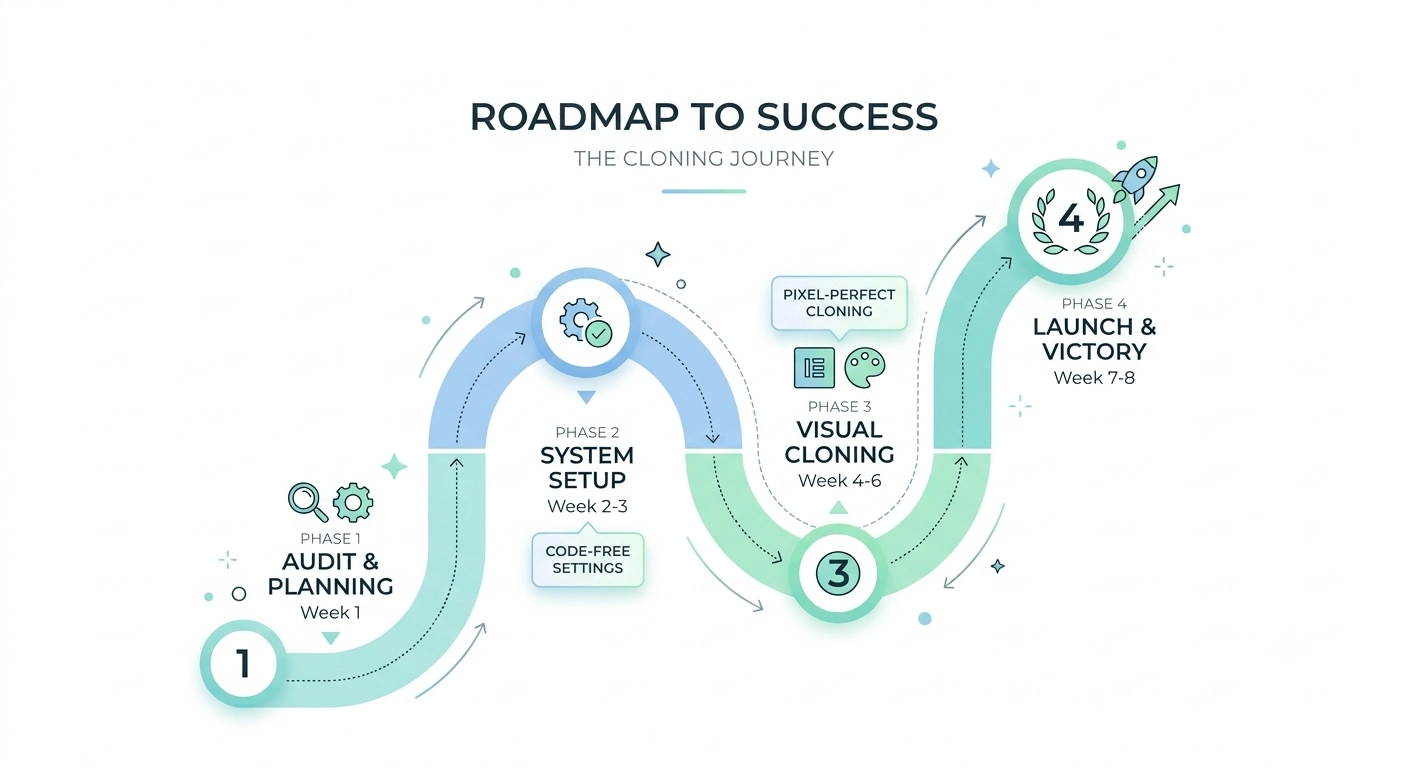
Phase Three: Dynamic Ecosystem Integration
The final phase of our Elementor website cloning blueprint involved recreating the interactive, data-driven sections of the site. To replace the custom-coded portfolio and filtering mechanism without writing PHP or JavaScript, we deployed a highly compatible extension stack consisting of Elementor Pro’s Loop Builder combined with the JetEngine ecosystem.
We built Custom Post Types (CPTs) for the portfolio entries, mapping custom meta fields for metadata such as client logos, project dates, and metrics. Using the Elementor Loop Builder, we visually designed a single portfolio card template that automatically pulled data from these custom fields. Finally, we implemented an advanced, AJAX-powered filtering grid, providing users with an instantaneous sorting experience across complex taxonomies.
To preserve historical system indexes and search engine rankings, we ran comprehensive sitemap routing and link validation checks. This step ensures that all freshly built dynamic archives match existing permalink paths perfectly. By verifying these backend query pipes, RoadCoderr safely transitioned the complex database into an agile visual application framework, fully prepared for commercial scaling.
Backup, Restore or Migrate SafelyCore Web Vitals & Performance Comparison
By avoiding heavy custom script overrides and utilizing Elementor’s native asset loading optimizations, the new site maintained an exceptionally lean footprint. The transition from a hardcoded stack to an agile, visual system delivered clean performance boosts across all desktop and mobile rendering nodes within 30 days of launch.
| Performance Indicator | Pre-Migration (Custom Code) | Post-Migration (Elementor) | Net Impact |
|---|---|---|---|
| Mobile Performance Score | 82 / 100 | 96 / 100 | +17.0% Boost |
| Desktop Performance Score | 94 / 100 | 99 / 100 | +5.3% Improvement |
| Largest Contentful Paint (LCP) | 1.4s | 1.1s | -21.4% Speed Increase |
| Time to First Byte (TTFB) | 280ms | 140ms | -50.0% Latency Drop |
This quantitative breakdown proves that an engineered approach to Elementor website cloning can easily match the rendering speed of custom-coded stacks while delivering massive content deployment velocity for internal marketing departments.
Backend Asset Optimization & Expansion Safety
A common concern with page builder setups is long-term performance decay as content expands throughout the business lifecycle. To safeguard this Elementor website cloning project against future bloat, we designed a comprehensive optimization pipeline on the backend. We implemented Redis object caching paired with an automated image-processing script that instantly converts all media uploads into modern formats.
Additionally, we utilized advanced asset-management tools to dequeue unused script fragments across specific page URLs, maintaining an exceptionally clean code-to-content ratio. To protect the newly migrated architecture from potential exploits, we added server-level firewalls, automated daily malware scanning, and isolated, off-site backup routines. The entire system is engineered for stability, allowing core updates to run smoothly without breaking custom layouts.
By combining the structural flexibility of Elementor Pro with meticulous backend optimization, we delivered a scalable visual platform that rivals the performance of custom frameworks, guaranteeing your brand remains fast, secure, and fully adaptable as your digital operations scale throughout 2026 and beyond.
Work With RoadCoderr
RoadCoderr is a full-service digital agency operating across top freelance networks like Fiverr and Upwork, providing specialized web development, custom malware removal, advanced speed optimization, and secure cloud migration frameworks. We reject superficial quick fixes, focusing entirely on long-term infrastructure stability, technical engineering excellence, and personalized care under the guidance of founder Sadekul Alam.
Whether your business platform requires a complex Elementor website cloning migration, deep database purification, or a secure server migration to eliminate developer bottlenecks, our technical desk is fully equipped to protect, optimize, and maintain your digital properties around the clock. Let us turn your operational risks into a showcase of resilient infrastructure.
Order WordPress Theme Installation Get Website Security and Updates Contact Our Migration Desk NowFinal Insight
The total migration of this enterprise platform demonstrates that long-term digital growth depends heavily on infrastructure discipline and flexible management frameworks. Without an agile editing workspace, hardcoded systems eventually cause marketing friction, inflate maintenance bills, and slow down your brand’s digital campaign velocity. Shifting to an optimized visual page builder breaks these operational bottlenecks cleanly.
With an engineered Elementor website cloning blueprint, your website shifts from an rigid developer-reliant system into a highly scalable, rock-solid commercial asset. The difference between constant technical delays and smooth, profitable customer acquisition is a proactive commitment to clean system organization and disciplined maintenance protocols. When your underlying software executes perfectly, your pages load instantly and conversions maximize naturally.
Do not wait for a structural delay to jeopardize your next marketing campaign or seasonal rollout. Proactive asset optimization guarantees that your brand remains authoritative, fast, and completely connected to your audience every second of the day. Secure your digital storefront today with a verified, elite technical solution from RoadCoderr.