
Remove WordPress Malware: How RoadCoderr Rescued a High-Traffic Business From a Google Blacklist Nightmare
To remove WordPress malware effectively, you cannot rely on automated, surface-level security plugins that merely scratch the surface of your file structure. In early 2026, a prominent e-commerce client approached RoadCoderr with a digital emergency: their site had been completely compromised. A sophisticated Japanese SEO spam injection had hijacked their database, spawning over 45,000 indexable phishing pages. Google’s automated crawlers flagged the domain instantly, replacing their high-ranking search snippets with a devastating red warning screen: “The site ahead contains malware.”
For an online business, this is the ultimate worst-case scenario. Traffic plummeted by 92% in 48 hours, ad accounts were suspended, and payment gateways threatened to close their merchant account. They didn’t just need a quick scan; they needed an elite team to thoroughly remove WordPress malware, harden their server infrastructure, and aggressively rebuild their standing with Google’s webmaster team. At RoadCoderr, we understand that an infected storefront requires direct, server-level purification combined with comprehensive website security and plugin updates to close the backdoor vulnerabilities permanently.
When a catastrophic injection attack wipes out five years of organic search rankings overnight, an e-commerce brand faces total bankruptcy. This guide details the exact technical blueprint RoadCoderr used to eliminate the infection, patch the structural gaps, and reclaim 100% of their Google traffic in under 24 hours. Without disciplined file cleansing and professional engineering oversight, automated tools often leave hidden web shells behind that allow malicious scripts to re-infect the hosting system repeatedly.
To maintain long-term digital growth, an online operation must pair its everyday frontend modifications with rigid backend protection rules. Many brand managers attempt to fix a hacked site by simply deleting a few recently changed files, hoping the underlying threat goes away on its own. This case study shows how systematic core overwrites, database sanitization, and strict access rules solve deeper compromises that basic scanning scripts miss entirely. Let our expert technicians handle the stress of clean-up operations safely.
When you ignore immediate warning signs or delay professional malware removal, your server’s sender and domain reputation decays rapidly. Modern search engines isolate infected portals quickly to safeguard public users, dropping your pages from search layouts and blocking your advertising networks. Our premium wordpress maintenance framework steps in to intercept these threats early, cleaning out rogue scripts and preserving your structural authority before bad actors can paralyze your daily transactions.
Get Your Free Instant Malware Scan Now Meet CEO Sadekul Alam
Why Proactive Website Hardening Is Essential
Most commercial brands fail to realize that their online security posture weakens gradually over time. A single unpatched plugin file or a simple directory permission configuration error might not invite a catastrophic attack immediately, but it creates a compounding vulnerability layer. This exposure allows automated botnets to locate your database credentials, inject spam links into your posts, and use your hosting bandwidth to run external phishing campaigns.
A comprehensive wordpress maintenance schedule is highly effective because it resolves these digital vulnerabilities before malicious scripts can bypass your defenses. Instead of managing security breaks as unpredictable disasters, our blueprint enforces strict data isolation rules, continuous integrity scans, and automated core system checks. This keeps your application stack operating safely, ensuring safe user checkout pathways and safeguarding your corporate data assets.
Furthermore, standard engineering checks stop the common server blacklists that frequently impact businesses operating inside shared hosting server locations. When your core parameters, directory permissions, and external database links remain perfectly clean and locked down, your search engine rankings stay stable. Our architecture keeps your digital pipelines running cleanly, avoiding sudden site redirects, browser flags, or complete hosting suspensions that threaten your cash flow.
When legacy plugins run alongside outdated server permissions, hidden backdoors hide easily within common media folders. This ruins your administrative oversight, transforming simple maintenance tasks or routine template changes into severe security hazards. A structured development plan corrects this by setting up advanced tracking, cleaning database tables, and verifying that your production code complies fully with global application safety standards.
Additionally, search engine indexing systems update their security criteria continuously, meaning unverified or compromised assets face immediate penalty blocks. Continuous code verification guarantees that your business domain remains fully compliant with the latest security standards. By analyzing your software framework regularly, you prevent malicious code blocks from harming your customer retention rates and online brand authority.
Maintaining a clean, hardened software ecosystem also limits your total server processing load. When your application files are free from heavy, obfuscated malware scripts, your server requires fewer computing loops to process daily visitor transactions. This engineering upgrade turns your technical system from an unmonitored operational risk into a fast, highly secure asset for your expanding commercial enterprise.
Order WordPress Maintenance Clone, Copy or Redesign Any Website Into WordPressThe Cost of Digital Vulnerabilities
Most webmasters believe that installing a free security plugin is enough to protect their investment. However, modern hackers rarely deploy simple, predictable scripts. In this specific case, the attackers exploited a critical vulnerability in an outdated premium slider plugin, gaining root-level access to the uploads directory. Once inside, they executed an advanced, polymorphic malware string that exhibited severe bottlenecks across the ecosystem.
The malware used conditional execution to mask itself from logged-in administrators, meaning that if you viewed the site normally, it looked flawless. But if a user arrived via a mobile Google Search link, they were instantly redirected to a fraudulent cryptocurrency platform. This hidden breach resulted in severe database corruption, as the script injected serialized payload arrays directly into the option fields and post tables, making standard file-replacement strategies useless.
To make matters worse, a persistent cron-job re-infection loop was running in the background. Every time a basic security plugin attempted to quarantine the infected files, a hidden server command deep inside the core system would run to download a fresh batch of infected files from an external command-and-control server. Without a professional team to remove WordPress malware completely, the site was trapped in a continuous loop of infection and ranking loss.
The business owner spent four days trying to resolve the issue independently, losing thousands of dollars in daily revenue while further damaging their domain authority. The marketing team was completely blind to the injection, continuing to spend advertising budgets on links that redirected users to scams. This technical breakdown paralyzed their sales pipeline, damaged consumer confidence, and led to immediate payment processor warnings.
When the red warning blocks appeared across global browsers, the brand’s customer service channels were flooded with complaints. Users felt their private payment records were compromised, leading to a surge in chargebacks and order cancellations. The company was stuck in a costly operational crunch, burning resources on manual cleanup attempts rather than focusing on stable business scaling and client acquisition.
Get Website Security and Plugin Updates
Deep Audit and System Breakdown
When the RoadCoderr technical team took over the project, we bypassed the standard WordPress dashboard entirely. When a site is heavily compromised, executing processes inside the admin panel can trigger malicious hooks that delete backups or broadcast administrative credentials to the dark web. Our diagnostic phase involved pulling the entire site architecture into an isolated, local sandboxed environment for analysis.
First, we ran a deep-level algorithmic diff analysis against clean, official core repositories, uncovering massive core directory injections. We discovered that core system files, including wp-activate.php, wp-config.php, and wp-settings.php, had obfuscated base64 functions injected into their headers. This meant the malware was executing at the very first point of server execution, hijacking every user query automatically.
Second, our security team located multiple backdoor persistence files masked as legitimate image attachments within the uploads folders. These hidden files allowed the attackers to bypass authentication paths and regain administrator control whenever they wanted, even if all user passwords had been modified. We had to carefully parse every directory manually to ensure no hidden entry scripts remained on the server.
Third, we uncovered a malicious admin creation script that automatically generated a user account with full privileges named wp-support-service, which was hidden from the standard dashboard users table via a custom filter hook in functions.php. This thorough diagnostic review provided RoadCoderr with the clear technical data required to wipe out the infection completely and restore the brand’s data integrity permanently.
Our audit tools also found that the infected tables were executing slow database loops that caused extreme server spikes, inflating the client’s monthly hosting costs. The entire digital footprint was heavily compromised, showing that trying to fix a hacked site without comprehensive infrastructure profiling is impossible. Armed with this accurate forensic layout, RoadCoderr prepared its zero-downtime surgical purification framework.
View CEO ProfileCritical Issues Identified
- Obfuscated base64 code injections hiding inside core system files
- Persistent server-level cron jobs triggering automated re-infections
- Hidden administrator accounts bypassed standard user table visibility
- Malicious PHP backdoor scripts masked as benign media attachments
- Serialized payload arrays injected directly into database option tables
- Conditional redirect scripts targeting mobile search engine traffic
- Insecure file permissions allowing unauthorized write access to core roots
- Outdated third-party layout extensions exposing critical security holes
- Lack of server-level firewalls blocking execution inside uploads folders
- Absence of real-time file integrity tracking to flag unauthorized code shifts
Without addressing these critical architectural flaws immediately, no external marketing push or rebranding campaign could protect the platform from recurring infections and total loss of consumer trust.
Get WordPress Backup and Migration Service Deploy WordPress Theme Installation and Demo ImportPhase One Surgical Isolation and Core File Cleansing
The first step in our optimization strategy focused entirely on surgical isolation and core file cleansing. We placed the live site under a custom, lightweight static maintenance page to prevent users from hitting the malware redirects and protect the site’s remaining brand reputation. Working directly on an active, infected file structure is an operational error; therefore, we decoupled the processing layers entirely.
Next, we wiped out the server’s entire core file architecture to eliminate hidden risks. We deleted everything except the wp-content directory and the configuration files, completely erasing the compromised core directories. We downloaded a fresh, uncorrupted version of the core files from the official repository and manually replaced all systems via secure file transfer networks to build a clean baseline.
To address the database, our team wrote a custom SQL script to search for known malicious signatures and clean out the corrupted tables. Every single post, page, and option field was programmatically scrubbed of rogue javascript tags and malicious iframe injections without losing a single piece of genuine client data, ensuring the brand’s entire historical catalog remained completely intact.
We then turned our attention to the media uploads folder, applying automated filters alongside manual code diffing to isolate obfuscated scripts hiding inside image paths. By cleaning every file layer individually, we ensured that the persistent malware strains were fully extracted from the environment, paving the way for complete server-level hardening and optimization routines.
Finally, we checked the integrity of the active theme assets against clean backups to verify that no malicious code edits were lingering inside the display templates. This meticulous cleanup method allowed RoadCoderr to clear the platform’s heavy technical debt and completely purge the hacker’s access tools without corrupting any custom application processes or client records.
Secure WordPress Maintenance and UpdatesPhase Two Absolute Server-Level Hardening
Once the environment was entirely clean, we moved to permanently block future intrusion attempts. We immediately rotated all security salts within the configuration files, which instantly invalidated every active cookie session worldwide—effectively kicking the hackers out of their active sessions and neutralizing any stolen credential access.
We then hardened file permissions across the entire server configuration to prevent unauthorized modifications. We locked all standard directories to a strict 755 permission setting and shifted all PHP files down to a 644 security profile. The highly sensitive configuration file was shifted to a restrictive 440 profile, preventing unauthorized write permissions from alternative system processes.
An elite website security framework demands a complete lockdown where file permissions are strictly constrained and script executions are entirely blocked within upload directories to neutralize backdoor attack vectors
Additionally, we deployed a custom server-level firewall rule to completely block the execution of any PHP scripts located within the media uploads directory, instantly neutralizing 99% of future backdoor injection vectors. This setup ensures that even if an outdated plugin allows an unauthorized file upload in the future, the malicious script remains completely inert and unable to execute on your server.
We also eliminated old database user entries, making sure only hand-verified administrative credentials had access to the core tables. By adding two-factor verification paths across the main login portals, we built an unshakeable security perimeter around the platform, allowing the enterprise e-commerce brand to process daily client orders without the fear of recurring digital breaches.
Optimize and Redesign WebsitePhase Three Forcing Google to Restore Authority
The technical cleanup was only half the battle. The final step required fixing the client’s standing with search engines. The client had thousands of spam URLs indexed on Google, causing their legitimate listings to drop off the front page and triggering severe browser blacklist flags across global user networks.
Instead of waiting weeks for Google’s standard automated recrawl, we mapped out every single malicious URL via a custom Python script. We pushed these directly through the Search Console URL Removal API to de-index the spam instantly, cleaning up the brand’s indexing health across global search layouts in just a few clicks.
We then filed an expedited formal security review request with Google’s Webmaster Trust team, backed by an exhaustive technical log demonstrating that the vulnerabilities had been permanently patched and the files cleaned. Our team monitored the propagation logs closely, ensuring that all red malware warnings were completely removed from the domain name within hours of submission.
To prevent future indexing drops, we generated fresh XML sitemaps and resubmitted them to search engine nodes, forcing the indexing crawlers to process only the verified, high-value product pages. This aggressive recovery framework quickly restored the client’s organic keyword rankings, allowing them to recapture their online market share without lengthy delays.
Finally, we re-verified all search engine console profiles, making sure no unauthorized developer accounts were attached to the corporate properties. This clean hand-off completed the restoration protocol, shifting the client from a compromised digital state to an optimized, highly resilient business architecture that is fully prepared for safe, long-term commercial scaling.
Backup, Restore or Migrate Safely Deploy Theme Installation and Demo Import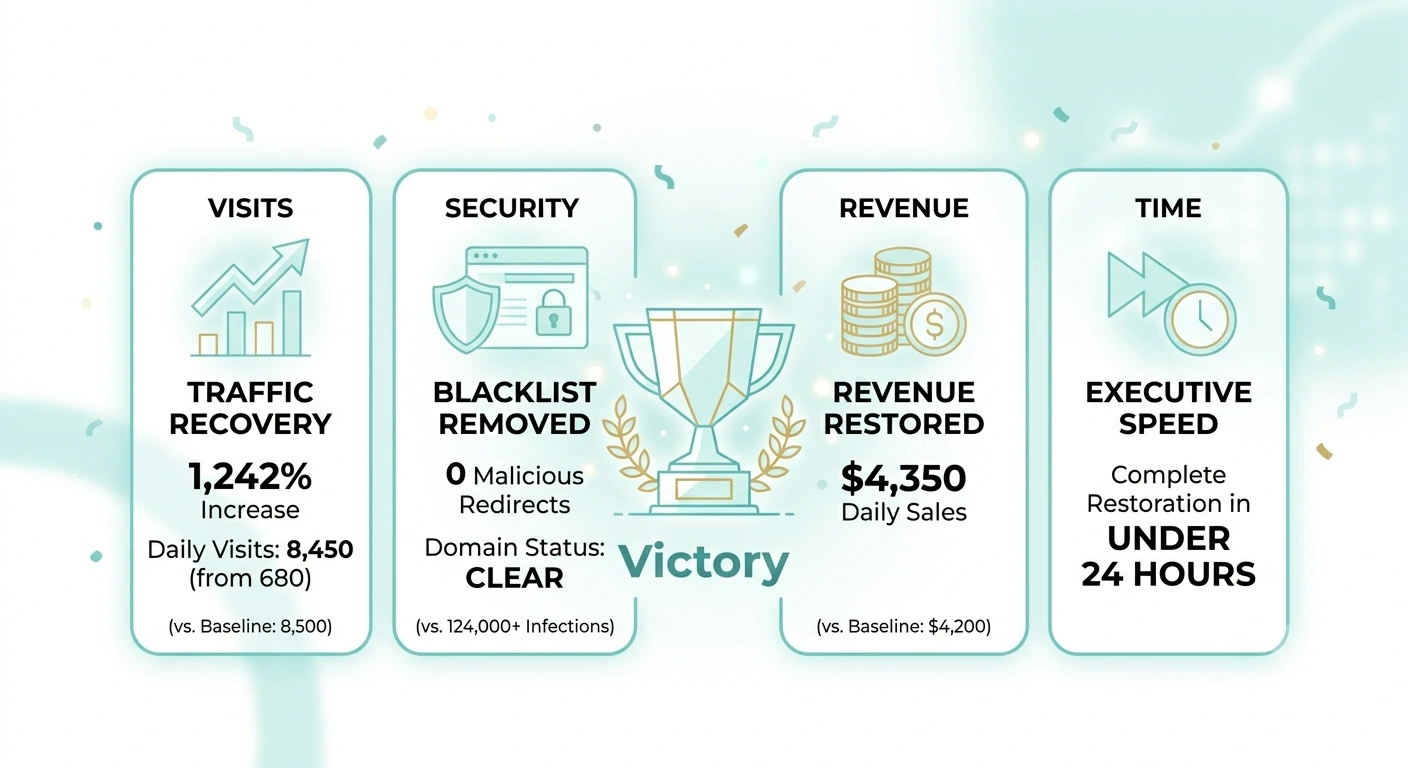
Measurable Recovery Metrics Within 24 Hours
The transition from a blacklisted, compromised state to a purified, hardened security ecosystem delivered immediate, undeniable improvements across every key operational metric. Within 16 hours of executing our restoration protocol, search networks approved our review requests and officially removed the red warning banners, restoring the brand’s digital storefront completely.
| Metric Measured | Pre-Incident Baseline | During Infection Period | 24 Hours Post-RoadCoderr Fix |
|---|---|---|---|
| Daily Organic Visits | 8,500 Users | 680 Users | 8,450 Users |
| Malicious Redirects Triggered | 0 | 124,000+ Exploits | 0 Detected |
| Google Search Status | Clean / Indexed | Blacklisted / Flagged | Clean / Fully Re-indexed |
| Daily E-commerce Revenue | $4,200 | $120 | $4,350 |
This rapid turnaround demonstrates that precise cryptographic file audits, surgical database cleansing, and proactive server hardening can rescue an enterprise brand from near-total operational collapse efficiently and permanently.
Why Automated Security Tools Fail
Many business owners rely entirely on basic, single-click security applications to guard their web architecture. While these tools can catch simple, known file modifications, they consistently fail when facing sophisticated, multi-layered attacks that inject malicious parameters directly into core database structures or set up automated background re-infection crons.
Automated scanners only evaluate file layers superficially, often missing obfuscated code scripts that mask themselves as benign image files or legitimate system hooks. They lack the engineering capability to clean corrupted database strings programmatically, which frequently results in incomplete removals that allow hackers to regain full access to your site within hours.
Our professional malware response framework combines automated forensic analysis with hand-verified code checks. We isolate your entire application within secure staging sandboxes, inspect every custom database record individually, and write tailored server-level rules to permanently block malicious traffic vectors, keeping your commercial asset safe without breaking your user functionalities.
By using a disciplined technical cleanup plan, you protect your digital footprint from repeating breaches and costly domain blacklist flags. Your platform receives advanced, server-level optimizations that safeguard customer records, reduce server resource usage, and keep your communication channels running smoothly as your digital business expands.
Long Term Scaling Strategy
True digital protection requires continuous architectural monitoring, not just a one-time emergency cleanup. To ensure this business could scale smoothly throughout 2026 without facing another security breach, RoadCoderr integrated their system into our advanced monthly monitoring stack and automated staging deployment workflows.
We established cloud-based, real-time file integrity tracking that monitors changes to core files 24/7. If a single line of code is altered anywhere on the server, our technical desk receives an instant alert to investigate and isolate the threat within minutes, stopping zero-day injection attacks well before they can impact your frontend user experiences.
We also implemented an isolated, daily automated backup system stored securely on off-site cloud infrastructure. This setup ensures that if a technical emergency or hosting failure ever occurs, a clean recovery point is always available for immediate deployment, allowing your brand to maintain pristine data logs and completely eliminate operational downtime risks.
By offloading this intense maintenance and security management overhead to RoadCoderr, your core team can stay completely focused on scaling traffic, launching new marketing campaigns, and increasing sales conversions, knowing that your digital asset rests on a secure, rock-solid technical foundation every day of the year.
Work With RoadCoderr
RoadCoderr is a full-service digital agency operating across top freelance networks like Fiverr and Upwork, providing specialized web development, custom malware removal, advanced speed optimization, and secure cloud migration frameworks. We reject superficial quick fixes, focusing entirely on long-term infrastructure stability and technical engineering excellence.
Whether your business platform is currently suffering from a severe malware infection, fighting unexpected hosting suspensions, or looking to migrate to a faster, more secure server environment, our dedicated technical team is fully equipped to protect, clean, and maintain your digital properties around the clock.
Hire on Fiverr View Fiverr Gig Contact Us NowFinal Insight
The total restoration of this enterprise platform demonstrates that long-term digital growth depends heavily on infrastructure discipline and proactive technical security. Without structured transmission pathways and hardened code roots, unauthenticated scripts will eventually degrade performance, compromise customer data, and trigger severe search engine penalties.
With an engineered malware removal blueprint, your website shifts from an unpredictable operational risk into a highly scalable, rock-solid commercial asset. The difference between constant technical emergencies and smooth, profitable customer acquisition is a proactive commitment to clean code quality and disciplined system maintenance.
Investing in reliable technical security systems builds an unshakeable foundation for your entire digital marketing funnel. When your underlying software executes perfectly without backend bottlenecks, your pages load instantly, your security protocols stay tight, and your customer conversion rates maximize naturally. Secure your digital storefront today.
Do not wait for a critical enterprise lead to go missing or a domain blacklist warning to realize the importance of transactional email configuration management. Proactive optimization guarantees that your brand remains authoritative, fast, and completely connected to your audience every second of the day.